
The Origin of Bachata: Where It Comes From and How It Conquered the World
Where does bachata come from? It originated in the Dominican Republic in the mid-20th century. Its origins, why it was kept off the radio, who first recorded it, and how it became world heritage.
Where does bachata come from?
Bachata comes from the Dominican Republic, where it was born in the mid-20th century in the country’s rural areas and working-class neighborhoods. For decades it was marginalized music, absent from the radio; today it is intangible cultural heritage of humanity and is danced all over the world.
That’s the short answer. The long one is a story spanning almost a century, running through marginalization, a dictatorship, a Grammy, and, more recently, Spain. Here it is, summarized but faithful to the essentials.
The origins: música de “amargue”
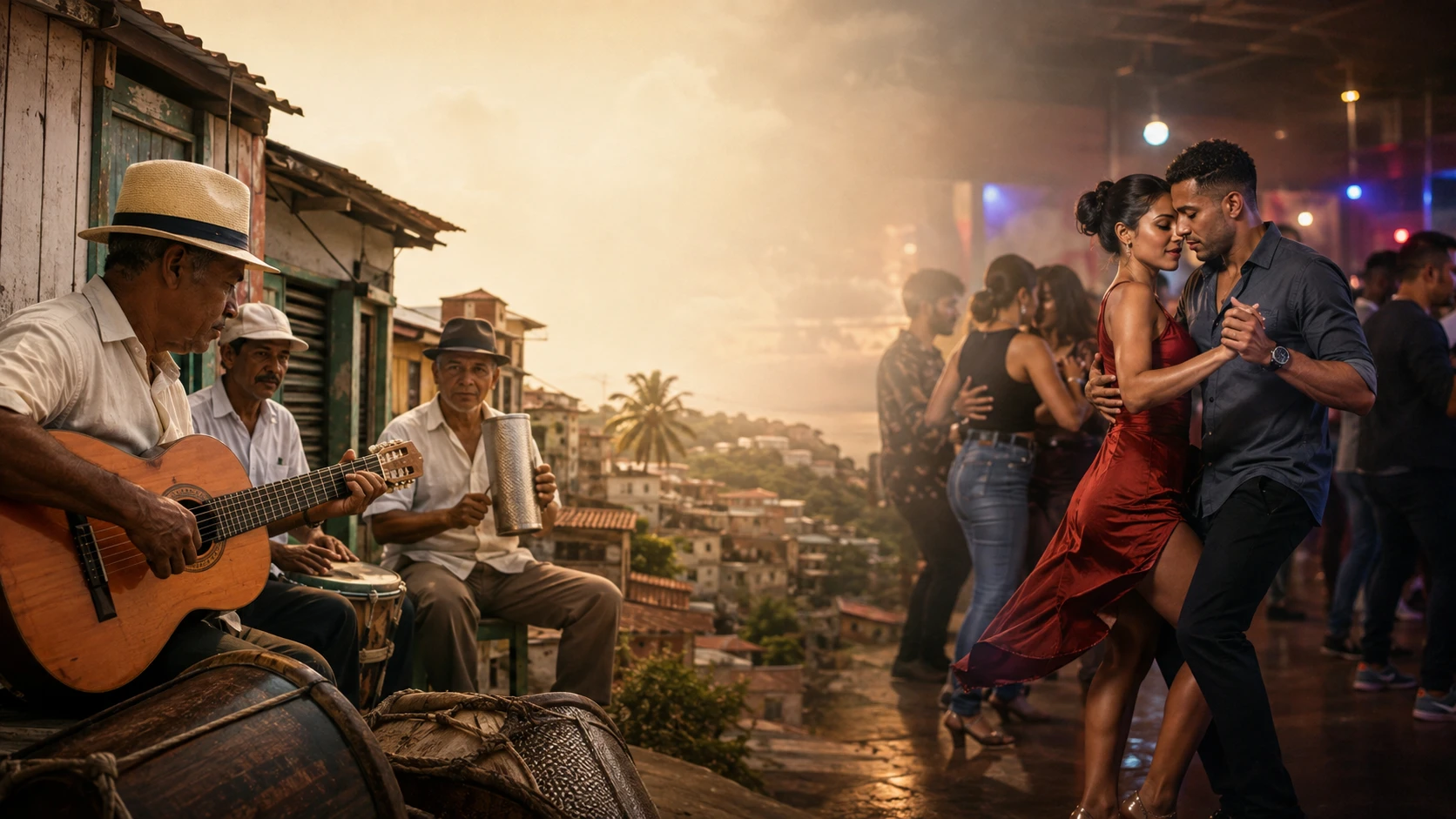
Bachata was born in the rural areas and working-class neighborhoods of the Dominican Republic, blending bolero, Cuban son, and other Afro-Caribbean rhythms that arrived via radio and record in the mid-20th century. At first it didn’t even have a fixed name: people called it “amargue” (bitterness) or “música de guardia”, because it spoke plainly about heartbreak, poverty, and everyday life, and it played in the colmados and parties of the poorest neighborhoods, with guitar, bongo, and güira.
The word “bachata” itself, before naming a musical genre, simply meant an informal backyard gathering, a get-together. The name stuck to the music that played at those gatherings, almost always used in a dismissive sense.
Repression and stigma
For much of the 20th century, bachata carried a class stigma. The Rafael Trujillo dictatorship (1930-1961) promoted merengue as the “national”, respectable music, while bachata remained associated with bars, brothels, and the country’s poorest sectors. Radio stations avoided it, and the Dominican middle and upper classes considered it music in poor taste, almost shameful.
That exclusion didn’t stop bachata from continuing to play and evolve for decades, sustained by the audience that genuinely felt it as their own. José Manuel Calderón is recognized as the first artist to commercially record bachata, in the early 1960s, opening the way for a generation of pioneers — Rafael Encarnación, Eladio Romero Santos, Luis Segura, among others — who kept the genre alive despite the official industry’s disdain.
From the margins to “Bachata Rosa”
The turning point came in 1990, when Juan Luis Guerra released Bachata Rosa, an album that polished the production without betraying the genre’s essence, and which won a Grammy. It was the first time bachata entered Dominican and international middle-class radios and homes as a matter of course. The music that had been a source of shame for decades started becoming a source of national pride.
Bachata conquers the world
In the 2000s, the group Aventura, led by Romeo Santos, brought bachata to a completely new audience: the Dominican diaspora in New York and, from there, to listeners who didn’t speak Spanish. They fused the genre with R&B and urban pop without losing its identity, multiplying its reach like never before.
That international success coincided with a parallel phenomenon on dance floors: bachata stopped being just a song and became a partner dance style in its own right too, increasingly present at social dance congresses and festivals around the world.
The birth of sensual bachata
In the mid-2000s, in Spain, Korke and Judith developed and systematized what is now known as sensual bachata: a style that deepens partner connection, body movement, and musicality, with a structured teaching methodology that hadn’t existed before. It isn’t a centuries-old tradition like Dominican bachata — it’s a recent, deliberate evolution, born outside the Dominican Republic but built on its roots.
World heritage
In 2019, UNESCO inscribed bachata on its Representative List of the Intangible Cultural Heritage of Humanity. A genre that had been banned from Dominican radio for decades ended up officially recognized as cultural heritage of the world. Few musical histories travel such a long road.
Today sensual bachata and Dominican bachata coexist as two branches of the same story, each with its own character, its own key figures, and its own way of understanding the dance.
Frequently asked questions
Where does bachata come from?
Bachata comes from the Dominican Republic. It was born in the mid-20th century in the country's rural areas and working-class neighborhoods, blending bolero, Cuban son and other Afro-Caribbean rhythms, and was played with guitar, bongo and güira.
What country is bachata from?
The Dominican Republic. Both the music and the dance are genuinely Dominican, although derived styles are now danced worldwide, such as sensual bachata, which developed in Spain in the mid-2000s.
Who invented bachata?
No single person invented bachata: it emerged collectively in Dominican neighborhoods and countryside. José Manuel Calderón is recognized as the first artist to record it commercially, in the early 1960s, and pioneers such as Rafael Encarnación, Eladio Romero Santos and Luis Segura kept the genre alive.
When did bachata originate?
Its roots go back to the mid-20th century, and the first commercial recordings date from the early 1960s. For decades it was known as 'amargue' or 'música de guardia' before the name bachata took hold.
Why was bachata banned?
More than legally banned, bachata was excluded and stigmatized. During Rafael Trujillo's dictatorship (1930-1961), merengue was promoted as the respectable national music while bachata was associated with bars and the poorest sectors. Radio stations avoided it and the middle and upper classes considered it music in poor taste.
What is the difference between Dominican bachata and sensual bachata?
Dominican bachata is the traditional style, with footwork and the flavour of the genre's roots. Sensual bachata is a recent, deliberate evolution developed in Spain in the mid-2000s by Korke and Judith, focusing on partner connection, body movement and musicality.